
All maps › School Lunch
Is school Lunch free in your country?
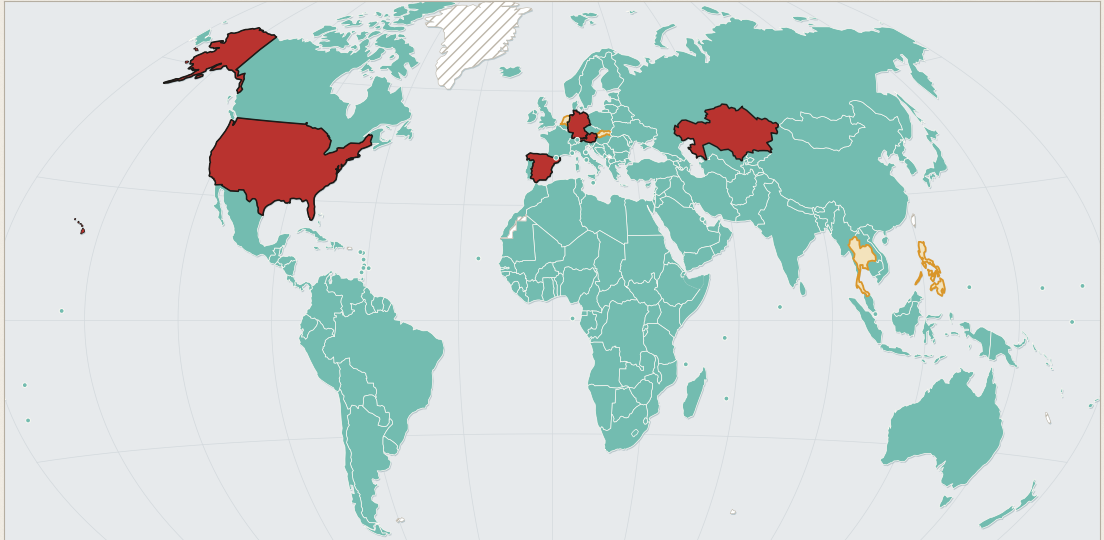
The 2026 map of where school Lunch is free or partly free, aired Nov 1, 2026. Sources
Sources: Global Child Nutrition Foundation, Global Survey of School Meal Programs country reports (2024) · National laws, ministries and budget decisions, 2024-26 · WFP country briefs and national press, 2025-26 · How we rate it
Is it free where you live? Check your countryShow the 77 countries where it is not free
No qualifying national law was found for these countries in the sources under Sources.
Free in 17 countries
Free hot lunch for every compulsory-school pupil by law.
Source: Skollagen 10 kap. 10 §
Why we rate it this way
Education Act (2010:800) ch.10 s.10: grundskola pupils must be offered nutritious school meals free of charge (GCNF 2024: 'free of charge for all students'); every primary pupil fed SY 2022-23.
Free school lunch for grades 1-9 since 2006.
Source: PGS s.42; Riigikogu 2025
Why we rate it this way
Basic Schools and Upper Secondary Schools Act s.42: free school lunch for grades 1-9 since 2006, upper secondary since 2015; state EUR 1/day + municipality (Riigikogu bill 969 SE memo, 2025).
Free lunch for every school child since 2022, any income.
Source: Law 2022; CE avis 2025
Why we rate it this way
Since 2022-23 up to five main meals a week free for every school-age child during school weeks, regardless of income, in chèque-service accueil structures (maisons relais); Conseil d'Etat avis on bill 7986, 2025.
Free meals for every primary pupil; grades 5-9 added in 2025.
Source: Gov. of Moldova, Feb 2025
Why we rate it this way
Free meals for all primary pupils; from Sep 2025 free breakfasts added for grades 5-9 (205m lei, gov.md 26 Feb 2025); universal for primary classes (GCNF 2024).
Free school meals for every pupil in grades 1-4.
Source: Ministry of Education 2026
Why we rate it this way
Free meals for all pupils in grades 1-4, plus rural grades 5-11 and benefit groups; meal allowances +5% from 1 Sep 2026 (edu.gov.by, Aug 2026).
A free hot meal every school day for grades 1-4 since 2020.
Source: Law on Education art. 37
Why we rate it this way
Federal Law of 1 Mar 2020 amending art. 37: at least one free hot meal a day for every grade 1-4 pupil in state and municipal schools since 1 Sep 2020 (KP guide 2026).
Free hot meal for every pupil in grades 1-4.
Source: Ministry of Education 2025
Why we rate it this way
Free hot meals for all pupils in grades 1-4 plus low-income pupils; ~1.4m primary pupils of 1.7m fed from 1 Sep 2025 (Ministry of Enlightenment; Bizmedia 3 Oct 2025).
Free hot lunch for grades 1-5 since 2021.
Source: Food at Schools Law 2019
Why we rate it this way
Law on Food Production and Services at Schools (2019): hot lunch for grades 1-5 since 2021, govt-funded 5 days a week; MNT 2,500 per pupil per day from 2025 (Save the Children Mongolia 2025); 100% of primary fed (GCNF 2024).
Free midday meal in every public school, pre-school to grade 5.
Source: Budget FY2020/21; FY25/26
Why we rate it this way
Midday meal made mandatory in all community schools, ECED to grade 5 (FY 2020/21 budget); ~3m children, ~USD 66.8m earmarked FY 2025/26 (ANI/Latestly 2026).
Free lunch for every public pupil from kindergarten to grade 6.
Source: Cabinet 2025 (InfoQuest)
Why we rate it this way
School lunch fund for every pupil Anuban 1 to Prathom 6: 5,894,420 students in 49,861 schools, 22-36 baht per head per day (Cabinet 2025, InfoQuest/Thairath).
Free school meals for every public school learner: 580,214 in 2025.
Source: Daily News (govt), Mar 2026
Why we rate it this way
National School Feeding: 580,214 learners in 2025, 'universal and non-discriminatory' for all public-school learners (Minister of Child Welfare and Basic Education, Mar 2026); breakfast + lunch for primary planned next FY.
Free school food in all 263 districts since 2025: 1.05m kids.
Source: Ley 7264/2024 Hambre Cero
Why we rate it this way
Ley 7264/2024 (universal school feeding fund) + Decreto 1584: Hambre Cero en las Escuelas in all 263 districts since Feb 2025, 1.05m children (Pena, Aug 2026; La Nacion Jun 2025); breakfast, lunch and/or snack.
Free lunch for every pupil in public elementary schools.
Source: GCNF 2024 country report
Why we rate it this way
School Food Service: universal free meals in public elementary schools (nationwide from the 2011 expansion; all grades in Seoul 2021); 2.67m of 2.70m primary pupils fed SY 2022-23, govt USD 5.79bn (GCNF 2024).
Free hot lunch for every pupil, every school day, since 1948.
Source: Basic Education Act s.31
Why we rate it this way
Basic Education Act 628/1998 s.31: a balanced meal free of charge every school day; 1943 act, nationwide in 1948 (Helsinki youth services); 364,644 of 371,364 primary pupils fed SY 2022-23 (GCNF 2024).
Free school meals for all 40 million public school pupils.
Source: Lei 11.947/2009 (PNAE)
Why we rate it this way
PNAE (Lei 11.947/2009): meals for every public basic-education pupil, ~40m (2025); Lei 15.226/2025 raises the family-farm share to 45% from 2026; universal, 100% of primary (GCNF 2024).
Free hot lunch for 112 million kids in government schools.
Source: PM POSHAN; Cabinet 2025
Why we rate it this way
PM POSHAN: one hot cooked meal each school day for 11.20 crore (112m) children, Balvatika to class 8, in 10.36 lakh government and government-aided schools; material cost +9.5% from 1 May 2025.
Free hot meals for every pupil in grades 1-11 since Sept 2026.
Source: Ukraine Cabinet, Jul 2026
Why we rate it this way
Grades 1-4 free nationwide since early 2025 (PM Svyrydenko, kmu.gov.ua 29 Dec 2025); Cabinet: all grades 1-11 in municipal schools, in-person or blended, from 1 Sep 2026, UAH 50/60 a day, UAH 7.4bn Sep-Nov (kmu.gov.ua 8 Jul 2026).
Everywhere not listed here, school Lunch is not free.
Partly free in 101 countries
Free only for low-income kids, or in the 9 states that pay for all.
Source: USDA NSLP; FRAC May 2026
Why we rate it this way
NSLP: free lunch only for households at or below 130% of the poverty line; Community Eligibility schools serve all free (55,362 schools in 2025-26, FRAC May 2026); 9 states pay for all: CA CO ME MA MI MN NM VT, NY from 2025-26 (CSPI 2026).
Free for every primary pupil in Wales; England only to age 7.
Source: Gov.Wales; DfE; Scot. Govt
Why we rate it this way
Wales: universal free meals for every primary pupil, no application (gov.wales 2026); Scotland: universal P1-P5, P6-P7 only with Scottish Child Payment (Feb 2025); England: universal Reception-Year 2, plus all Universal Credit families from Sep 2026; NI means-tested.
Every primary school can claim free hot lunch; not all serve it yet.
Source: Irish Examiner, 2026
Why we rate it this way
Hot School Meals: all primary schools made eligible in 2025 (Calleary Apr/Aug 2025; ~550,000 children, EUR 3.20/child/day, 2026 budget EUR 286m - Irish Examiner 2026); schools opt in and the last ~350 were delayed by new procurement rules (Farmers Journal 2025).
Free for low-income families; only Berlin feeds all grades 1-6 free.
Source: SGB II s.28; Berlin 2025
Why we rate it this way
Bildungs- und Teilhabepaket: free lunch for children of Buergergeld, Wohngeld and Kinderzuschlag families since 1 Aug 2019 (Starke-Familien-Gesetz); Berlin: lunch free for all grades 1-6 (Senate; kept, news4teachers Jul 2025). Other states charge parents.
Free meals only in schools where many families are low-income.
Source: OCW / VO-raad 2025
Why we rate it this way
Programma Schoolmaaltijden: free meals in schools where >=30% of pupils are from low-income homes; EUR 135m structural in the 2025 budget; current form extended to end of 2025-26 (VO-raad). ~1 in 5 schools in 2023.
Free school meals only for children from low-income families.
Source: GCNF 2024 country report
Why we rate it this way
Government programme 'Posilek w szkole i w domu' (Ministry of Family): free meals by family income in public schools; families otherwise pay (GCNF 2024, SY 2022-23).
The state pays lunch only for children from low-income homes.
Source: GCNF 2024 country report
Why we rate it this way
State subsidy (Education + Labour ministries) for lunches of children from low-income families; CZK 217m in 2022; other families pay (GCNF 2024, SY 2022-23).
Free for kids on child-protection benefit; big families pay half.
Source: Gyvt. 21/B; Eduline 2025
Why we rate it this way
Child Protection Act s.21/B: free school meals for pupils on regular child-protection allowance, in care or in disability institutions; 50% off for families with 3+ children (Eduline 13 Aug 2025, SY 2025-26).
A free hot meal only in schools picked for the national programme.
Source: GCNF 2024 country report
Why we rate it this way
'Masa sanatoasa' (Ministry of Education): hot meal in schools selected in isolated, poor or disadvantaged areas (GCNF 2024, SY 2022-23).
Free lunch for every pupil, but only in schools in the programme.
Source: GCNF 2024 country report
Why we rate it this way
School Meals programme (Rural Development + Education ministries) in schools that opt in; DIATROFI (Prolepsis) feeds every pupil in schools chosen by socio-economic criteria (GCNF 2024).
Free only for the lowest-income band; others pay about EUR 1.46.
Source: ASE rules; Cascais 2025
Why we rate it this way
Accao Social Escolar: escalao A (lowest abono band) meals free, B pays 50%, C pays full (EUR 1.46 per meal in 2025, Cascais ASE page; Matosinhos 2025-26 flyer).
Every primary pupil gets one free EUR 1.33 meal, usually a snack.
Source: Govt decision NN 81/2026
Why we rate it this way
Govt decision for 2026-27 (NN 81/2026, 24 Jul 2026; same in NN 108/2025): state pays EUR 1.33 per pupil per school day for one meal for every primary pupil (EUR 2 in full-day pilot schools); usually a marenda (Novi list).
Free lunch for grades 1-4 nationwide; older pupils depend on the town.
Source: Finance Ministry, Feb 2026
Why we rate it this way
2026 state budget: EUR 22m for free lunches for grades 1-4 (Finance Ministry, Feb 2026), co-paid 50/50 with municipalities (Daugavpils 2025 budget); grades 5-6 up to each municipality.
Free lunch for every child up to grade 2; after that, by income.
Source: Law on Soc. Assist. Pupils
Why we rate it this way
Law on Social Assistance for Pupils: free lunch for pre-primary and grades 1-2 regardless of income (since 2020/2021); grades 3+ only by family income (socmin.lrv.lt; GCNF 2024).
Free in towns that join a 2024-27 state scheme, incl. Reykjavik.
Source: Althingi, Jun 2024
Why we rate it this way
Temporary provision in Act 4/1995 (passed 22 Jun 2024): state grants 2024-27 to municipalities that offer free meals to all compulsory-school pupils; Reykjavik free in 2025-26; Ministry working group report 27 Jun 2025. Not confirmed for every municipality.
Free breakfast for pupils in need; school lunch is paid.
Source: GCNF 2024 country report
Why we rate it this way
Free Breakfast to Pupils in Need (a sandwich, since 2013) by family income; lunch in all-day schools paid by parents (GCNF 2024).
Free daily lunch only for pupils from low-income families.
Source: GCNF 2024 country report
Why we rate it this way
Scheme 9: free daily healthy lunch for public-school pupils from low-income families (GCNF 2024).
Free school meals only for families below an income limit.
Source: GCNF 2024 country report
Why we rate it this way
Ministry of Education school meals for pupils of families below income and asset thresholds; 13% of primary pupils (GCNF 2024).
Free meals for grades 1-4 in every region except Yerevan.
Source: WFP study; ARKA Aug 2025
Why we rate it this way
State-funded free meals for grades 1-4 in all 10 regions since 2023 (~102,000 pupils, WFP case study); Yerevan not yet covered, a capital programme is being designed (ARKA, Aug 2025).
Free meals for grades 1-4, rolled out region by region since 2022.
Source: GCNF 2024 country report
Why we rate it this way
Free meals for grades 1-4 from 2022 in Karakalpakstan and Khorezm (1,260 schools, GCNF 2024); a 2023 state programme extended it to other regions (Kun.uz 24 Aug 2023); 2025-26 nationwide coverage not confirmed.
Grades 1-4 get a state meal; some schools ask parents to add money.
Source: GCNF 2024 country report
Why we rate it this way
State school meals for grades 1-4 (Ministry of Education, with WFP optimisation in some schools); in some schools parents add funding (GCNF 2024).
Meals for grades 1-4 reach about 7 in 10 primary pupils.
Source: GCNF 2024 country report
Why we rate it this way
School meals for grades 1-4 (ages 7-11) and pre-school; 72% of primary pupils fed (GCNF 2024, SY 2022-23).
Free lunch only for bused and boarding pupils, about 1 million.
Source: MEB; Cumhuriyet Dec 2025
Why we rate it this way
Free lunch for bused (tasimali) and boarding pupils (~1m, MEB) and preschool in the quake zone; free meal for all rejected (Cumhuriyet Dec 2025; 2026 budget debate 18 Dec 2025).
State-funded lunch mostly in poorer areas; families pay part.
Source: GCNF 2024 country report
Why we rate it this way
Ministry of Education meals in long-school-day schools (YOCHA, ages 3-10); state support by socio-economic index, families pay part (GCNF 2024).
School meals only in the poorest districts.
Source: GCNF 2024 country report
Why we rate it this way
Ministry of Education school feeding in the most vulnerable districts (Ministry of Planning survey); 8% of primary pupils (GCNF 2024).
A free daily snack for KG to grade 6, in poorer areas only.
Source: GCNF 2024 country report
Why we rate it this way
National school nutrition programme, KG to grade 6 in poverty pockets; 40% of primary pupils (GCNF 2024).
Free school snacks only in the poorest areas.
Source: GCNF 2024 country report
Why we rate it this way
Ministry of Education + WFP: in-school snacks for grades 1-6 by poverty and nutrition need; 33% of primary pupils (GCNF 2024).
School food only in the poorest and war-hit areas.
Source: GCNF 2024 country report
Why we rate it this way
Ministry of Education school feeding unit + WFP: grades 1-9 targeted by poverty, displacement and war zones (GCNF 2024).
A free daily snack for millions of pupils, not a full lunch.
Source: WFP brief 2026; Zawia3
Why we rate it this way
National School Feeding Programme: fortified snack (biscuit/date pastry) for ~12.5m public-school pupils (WFP); EGP 7bn for 2026/27, ~19.5m students (Finance Minister via Zawia3, 2026).
Free canteens mostly for rural pupils, about 3 in 10.
Source: GCNF 2024 country report
Why we rate it this way
Ministry of Education canteens, mainly rural, by distance and family situation; 31% of primary pupils (GCNF 2024).
Free canteens in many primary schools; some still have none.
Source: Radio Algerie; APS Sep 2025
Why we rate it this way
Free primary-school canteens, aim to reach every primary pupil (+100,000 a year, Education Minister, Radio Algerie); new canteens opened for 2025-26 (APS via AllAfrica, Sep 2025); many schools still lack one (Algerie360).
Cheap canteens for needy and rural pupils only.
Source: GCNF 2024 country report
Why we rate it this way
School canteens for needy, rural and border-area pupils; families pay a partial price (GCNF 2024).
A free daily meal for 9.5 million kids in poorer schools, 8 in 10.
Source: The Outlier, Aug 2026
Why we rate it this way
National School Nutrition Programme: ~9.5m learners, almost 80% of government-school learners, get at least one free meal a day in quintile 1-3 schools (The Outlier 27 Aug 2026; Ramaphosa Oct 2025: 9.7m).
Free meals reach about 3 million kids in 34 of 47 counties.
Source: Kenya News Agency, Oct 2026
Why we rate it this way
National school meals: ~3m learners in 34 of 47 counties (govt, Oct 2026), shortfall KSh4.8bn; Nairobi's Dishi na County charges KSh5 a meal (Capital FM 2024).
Free lunch aimed at public primary 1-3 in states that take part.
Source: NSIPA via Nairametrics 2025
Why we rate it this way
Renewed Hope National Home-Grown School Feeding relaunched 29 May 2025 for public primary 1-3; plan to extend to primary 1-6 by 2026 (NSIPA, Nairametrics 14 Sep 2025).
Free lunch for KG to primary 6, in poorer communities.
Source: GCNF 2024 country report
Why we rate it this way
Ghana School Feeding Programme: KG1 to primary 6 in especially poor communities; 76% of primary pupils (GCNF 2024).
School meals only in food-insecure and drought-hit areas.
Source: GCNF 2024 country report
Why we rate it this way
Ministry of Education school feeding, pre-primary to grade 8, in food-insecure, drought- or conflict-hit areas; 38% of primary pupils (GCNF 2024).
School lunch for every pupil, but parents pay RWF 975 a term.
Source: MINEDUC; New Times 2026
Why we rate it this way
National school feeding for all pupils (4.4m by 2024; govt ~90% of cost); parents pay RWF 975 per term for pre-primary/primary, rising to RWF 2,000 from Jan 2027 (New Times; Umwalimu SACCO).
The government lunch reaches about 8 in 10 primary pupils.
Source: GCNF 2024 country report
Why we rate it this way
Government school feeding (lunch) for primary pupils: 251,364 of 315,345 enrolled fed in 2022 (GCNF 2024); USDA-funded CRS programme for ~17% cut in 2025 (GroundUp, Jun 2025).
Free mid-morning porridge in public schools, not a full lunch.
Source: GCNF 2024 country report
Why we rate it this way
National School Feeding Programme in public schools, pre-primary to grade 7 (mid-morning maize-blend porridge); 76% of primary pupils (GCNF 2024).
School meals reach about 2 in 3 pupils; families pay a share.
Source: GCNF 2024 country report
Why we rate it this way
Home-Grown School Feeding by grade and school type; families pay a partial price; 67% of primary pupils (GCNF 2024).
School meals reach about 6 in 10 primary pupils.
Source: GCNF 2024 country report
Why we rate it this way
Ministry of Education school meals, ECE to grade 7, 4 days a week; 61% of primary pupils (GCNF 2024).
School meals in public primary schools in food-insecure areas.
Source: GCNF 2024 country report
Why we rate it this way
Ministry of Education school meals in public primary schools picked by food insecurity and emergencies; 52% of primary pupils (GCNF 2024).
School meals reach about 1 in 10 primary pupils.
Source: GCNF 2024 country report
Why we rate it this way
National school feeding (PRONAE) and partners in selected primary schools; 9% of primary pupils (GCNF 2024).
School meals reach about half of primary pupils.
Source: GCNF 2024 country report
Why we rate it this way
Ministry of Education + local government programmes in public day schools, narrowed to some regions; 49% of primary pupils (GCNF 2024).
Free school meals mainly in Karamoja; elsewhere parents pay.
Source: GCNF 2024 country report
Why we rate it this way
Government school feeding mainly in Karamoja (food-insecure region); elsewhere parents fund meals; 14% of primary pupils (GCNF 2024).
School canteens in poorer areas; families pay part.
Source: GCNF 2024 country report
Why we rate it this way
Directorate of School Canteens + WFP in vulnerable areas; families pay part in most programmes; 14% of primary pupils (GCNF 2024).
Cheap school canteens reach about 1 in 4 primary pupils.
Source: GCNF 2024 country report
Why we rate it this way
School Canteens Directorate, by school type and area; families pay a partial price; 23% of primary pupils (GCNF 2024).
State canteens in public primary schools, with partner aid.
Source: GCNF 2024 country report
Why we rate it this way
Ministry of Education canteens in public primary schools, reported universal in SY 2022-23 (GCNF 2024); insecurity and partner funding make 2025-26 delivery uncertain.
Near-free canteens in about half of public primary schools.
Source: GCNF 2024 country report
Why we rate it this way
National Integrated School Feeding (PNASI) in rural public primary schools; families pay up to 25 FCFA; 52% of primary pupils (GCNF 2024).
School canteens reach about 1 in 10 primary pupils.
Source: GCNF 2024 country report
Why we rate it this way
National school canteens (ANADEB) by poverty and food insecurity; 11% of primary pupils (GCNF 2024).
School canteens reach about 1 in 5 primary pupils.
Source: GCNF 2024 country report
Why we rate it this way
National Directorate of Basic Education canteens in food-insecure and conflict areas; 19% of primary pupils (GCNF 2024).
School canteens reach about 1 in 6 primary pupils.
Source: GCNF 2024 country report
Why we rate it this way
Ministry + WFP canteens in crisis, conflict and nomadic areas; 17% of primary pupils (GCNF 2024).
School canteens reach about half of primary pupils.
Source: GCNF 2024 country report
Why we rate it this way
Directorate of Nutrition and Health Education canteens in every wilaya, mostly the most vulnerable areas; 47% of primary pupils (GCNF 2024).
School canteens reach fewer than 1 in 10 primary pupils.
Source: GCNF 2024 country report
Why we rate it this way
National School Canteens Directorate, preschool and primary in vulnerable areas; 8% of primary pupils (GCNF 2024).
School meals in the most vulnerable regions, about half of pupils.
Source: GCNF 2024 country report
Why we rate it this way
Ministry of Basic Education (SAFMU): ECD and public grades 1-6 in the most vulnerable regions; 48% of primary pupils (GCNF 2024).
School meals reach about 4 in 10 primary pupils.
Source: GCNF 2024 country report
Why we rate it this way
National school feeding with WFP/CRS by vulnerability index; 39% of primary pupils (GCNF 2024).
School meals reach under half of primary pupils.
Source: GCNF 2024 country report
Why we rate it this way
Ministry of Education with partners in selected public schools; families give in-kind help; 45% of primary pupils (GCNF 2024).
School meals only in vulnerable, low-enrolment communities.
Source: GCNF 2024 country report
Why we rate it this way
Ministry of National Education school meals, pre-primary to grade 6 in vulnerable, low-enrolment communities (GCNF 2024).
State-funded canteens in public schools; 9 in 10 pupils fed.
Source: FICASE; GCNF 2024
Why we rate it this way
FICASE funds canteens of all public schools (Resolucao Jan 2026, 2025-26 budget CVE 115.4m); 89% of primary pupils fed in 2022-23 (GCNF 2024); free for every pupil not confirmed.
School meals for all pupils by law; many children not reached.
Source: Law 01/2023; WFP 2025
Why we rate it this way
Law 01/2023 (PNASE) gives every pre-primary and basic-school pupil the right to school meals; WFP 2025: universal model but only ~56% of school-age children enrolled to benefit.
School canteens reach about 3 in 100 primary pupils.
Source: GCNF 2024 country report
Why we rate it this way
Ministry of Basic Education + WFP canteens in vulnerable areas; 3% of primary pupils (GCNF 2024).
School canteens reach fewer than 1 in 10 primary pupils.
Source: GCNF 2024 country report
Why we rate it this way
Directorate of Food and Nutrition canteens by geography and food insecurity; 8% of primary pupils (GCNF 2024).
School meals reach about 3 in 10 primary pupils.
Source: GCNF 2024 country report
Why we rate it this way
WFP + Ministry of National Education, schools with high food insecurity and dropout; 29% of primary pupils (GCNF 2024).
School canteens reach fewer than 1 in 5 primary pupils.
Source: GCNF 2024 country report
Why we rate it this way
Ministry of National Education canteens in poor-nutrition districts, plus NGO programmes; 18% of primary pupils (GCNF 2024).
School meals reach about 1 in 5 primary pupils.
Source: GCNF 2024 country report
Why we rate it this way
Ministry of Education + WFP for children who could not otherwise afford school; 21% of primary pupils (GCNF 2024).
Free canteens in rural schools only.
Source: GCNF 2024 country report
Why we rate it this way
Every rural school has a canteen (geographic targeting); 22% of primary pupils (GCNF 2024).
School meals 3 days a week for under 4 in 10 primary pupils.
Source: GCNF 2024 country report
Why we rate it this way
Ministry of Education + Social Action with WFP, by school type and need, 3 times a week; 37% of primary pupils (GCNF 2024).
School canteens reach about 1 in 5 primary pupils.
Source: GCNF 2024 country report
Why we rate it this way
Government and WFP canteens for pre-school, primary and indigenous pupils by vulnerability; 22% of primary pupils (GCNF 2024).
Free breakfast and lunch in state schools; 3 in 4 pupils use it.
Source: Nation.sc, May 2024
Why we rate it this way
Free breakfast and lunch in state schools since 30 Jun 2022; 75% of primary pupils (creche-P6) benefited in late 2023 (Nation, 4 May 2024); growing in 2025 (Nation, Jun 2025).
Free snacks for 3.1 million pupils in the poorest areas.
Source: ECNEC Mar 2025; Prothom Alo
Why we rate it this way
School Feeding Programme (Tk 5,452 crore, ECNEC Mar 2025) since Nov 2025: 3.13m pupils in 19,419 primary schools in 150 poverty-mapped upazilas; biscuits, fruit, bread, egg, milk; rest of country planned.
Free midday meal for grades 1-5 in most, not all, state schools.
Source: Newsfirst, Mar 2024
Why we rate it this way
From 25 Mar 2024: free midday meal for all grade 1-5 pupils in 9,134 government schools and all schools under 100 pupils (Rs 16.6bn); not every school; 2025-26 status not confirmed.
School meals reach about 3 in 4 primary pupils.
Source: GCNF 2024 country report
Why we rate it this way
Ministry of Education school feeding for boarding and selected day schools; 73% of primary pupils (GCNF 2024).
School meals reach about 1 in 8 primary pupils.
Source: GCNF 2024 country report
Why we rate it this way
Ministry of Education + WFP home-grown school feeding in vulnerable areas, up to grade 6; 12% of primary pupils (GCNF 2024).
School meals reach under 3 in 10 primary pupils.
Source: GCNF 2024 country report
Why we rate it this way
Ministry of Education and partners, pre-school and primary in vulnerable districts; 28% of primary pupils (GCNF 2024).
5 yuan a day for rural pupils' meals; most city kids pay.
Source: China Daily, Jul 2026
Why we rate it this way
Rural compulsory-education nutrition plan: 5 yuan per pupil per day in designated counties (expanded 2025 to urban areas of ex-poverty counties, MoE via China Daily Jul 2026); ~37m pupils, ~25% (Frontiers 2025).
State pays 5,200 yen a month since Apr 2026; some towns bill extra.
Source: MEXT, Apr 2026
Why we rate it this way
From Apr 2026 the state pays JPY 5,200 per public elementary pupil per month for lunch ingredients, no income limit; MEXT avoids the word 'free': towns may still bill parents above the standard (e.g. Sayama +JPY 300).
Free meals reached 48 million students by mid-2026, not all yet.
Source: Kompas TV / BGN, Jun 2026
Why we rate it this way
Makan Bergizi Gratis since Jan 2025: 48.2m students fed as of 1 Jun 2026 (BGN via Kompas TV), short of the 82.9m-recipient 2026 target; food-poisoning cases reported.
Free meals only for low-income primary pupils (RMT).
Source: GCNF 2024; Sinar Harian 2026
Why we rate it this way
RMT supplementary food plan for low-income (B40), special-needs and Indigenous pupils; meals free in all public preschools (GCNF 2024); 2026 Selangor free breakfast adds to RMT.
Free meals for kinder and underweight kids, 120 days a year.
Source: DepEd; Phil. Star 2025
Why we rate it this way
School-Based Feeding Program (RA 11037): all public Kinder (and Grade 1 from SY 2026-27) plus wasted/stunted Grades 2-6, 120 days (DepEd Jul 2025); 2026 budget P25.7bn for 200 days.
Free lunch only in border communes; Hanoi subsidises others.
Source: QDND 2025; Hanoi resol.
Why we rate it this way
Party chief To Lam: free school lunches in land-border communes from 2025-26 (QDND 2025); Hanoi subsidises primary main meal VND 20,000-30,000/day (2025); no national rule.
Free lunch only in schools in poorer areas, about 235,000 kids.
Source: Ministry of Education 2026
Why we rate it this way
Ka Ora, Ka Ako: free lunch for all pupils in lower-advantage schools (~235,000 students); funded for 2025-2026 and extended a year (Ministry of Education; 1News Oct 2026).
By law Q6 a day of school food per pupil; a snack, not lunch.
Source: Decreto 12-2021; AGN 2025
Why we rate it this way
Ley de Alimentacion Escolar (Decreto 16-2017, reformed 12-2021): Q6 a day per public pre-primary and primary pupil, a mid-morning refaccion bought by parents' groups; 86% of primary pupils fed 2022 (GCNF 2024); restarted for 2025 (AGN).
A free daily merienda for public pupils, but days get missed.
Source: El Heraldo 2025; ASJ
Why we rate it this way
Merienda escolar for ~1.26m pre-basic and basic pupils in 20,000+ public centres (Sedesol 2025, L1,100m); delivered 143 of 170 days in 2024, 27 days missed in 2025 (ASJ).
A free breakfast snack for public pupils, not a lunch.
Source: elsalvador.com 2026
Why we rate it this way
PASE: daily refrigerio (breakfast/snack) early in the day for public-school pupils, parvularia to bachillerato ($13.85m food purchase 2026); 89% of primary pupils fed (GCNF 2024).
A free breakfast snack for public pupils; no free lunch.
Source: GCNF 2024 country report
Why we rate it this way
Programa de Alimentacion Escolar: universal breakfast snack for public EGB pupils; 97% of primary pupils fed (GCNF 2024).
Free breakfast in public schools; lunch only in some areas.
Source: MIDIS, Apr 2025
Why we rate it this way
Wasi Mikuna (DS 010-2024-MIDIS) replaced Qali Warma: target 4.26m students in 67,575 public schools in 2025, breakfast and/or lunch by area (MIDIS to Congress, Apr 2025).
Free meals in public schools; lunch mainly in full-day schools.
Source: INABIE / Presidencia 2025
Why we rate it this way
PAE (INABIE): 1bn+ rations in 2025 for 2.1m in 7,000+ public centres; breakfast and lunch mainly in Jornada Escolar Extendida schools (Presidencia 2025).
School dining halls, with priority by family income.
Source: GCNF 2024 country report
Why we rate it this way
PANEA student dining halls in public schools; eligibility by income and vulnerability (GCNF 2024).
Free school meals reach about 85% of public pupils.
Source: Radio Nacional 2026
Why we rate it this way
PAE (Alimentos para Aprender): 85.5% coverage of official-school pupils in 2026 (Radio Nacional), prioritising lower grades; universal goal for 2026 (GCNF 2024).
Free meals by school vulnerability, about half of pupils.
Source: GCNF 2024 country report
Why we rate it this way
JUNAEB PAE in public and state-funded schools, targeted by school vulnerability and rurality; 48% of primary pupils (GCNF 2024).
Free school meals for about 6 in 10 primary pupils.
Source: GCNF 2024 country report
Why we rate it this way
Primary education directorate school meals, kindergarten to grade 9 by school type; 58% of primary pupils (GCNF 2024).
Provinces run free canteens for needy pupils, partly nation-funded.
Source: Chequeado 2025
Why we rate it this way
School canteens run by provinces with national co-funding under 4-year agreements (Capital Humano, 2024); Buenos Aires SAE feeds 2.5m pupils; national share fell 20.6% in real terms 2023-25 (Chequeado 2025).
Free lunch only for kids from welfare (PATH) families.
Source: GCNF 2024 country report
Why we rate it this way
Ministry of Education + Labour: free lunch for PATH (social-assistance) students; others can buy meals; 21% of primary pupils (GCNF 2024).
Free meals only for public pupils from low-income homes.
Source: GCNF 2024 country report
Why we rate it this way
National Schools Dietary Services: public-school pupils from low-income or grant-receiving households (GCNF 2024).
Free meals only for students from low-income homes.
Source: GCNF 2024 country report
Why we rate it this way
Ministry of Education meals for students from lower socio-economic backgrounds (Social Services assessment); 18% of primary pupils (GCNF 2024).
School meals only in some Belize City schools.
Source: GCNF 2024 country report
Why we rate it this way
Ministry of Education school meals only in Belize City (Southside) schools; 1% of primary pupils (GCNF 2024).
School meals in nutrition-risk areas; most families pay.
Source: GCNF 2024 country report
Why we rate it this way
Government school feeding in nutrition-risk areas; families pay partly or fully (GCNF 2024).
Free meals only for children of families in hardship.
Source: GCNF 2024 country report
Why we rate it this way
Ministry of Education meals for children of households in financial difficulty (voluntary registration) (GCNF 2024).
Free meals only for pupils assessed as in need.
Source: GCNF 2024 country report
Why we rate it this way
Ministry of Education school meals by individual student need (GCNF 2024).
School canteens reach fewer than 1 in 10 primary pupils.
Source: GCNF 2024 country report
Why we rate it this way
MENFP school canteens by grade and school; 7% of primary pupils (GCNF 2024).
All 195 countries: is school lunch free?
 AfghanistanNot free
 AlbaniaNot free
 AlgeriaPartly free
 AndorraPartly free
 AngolaPartly free
 Antigua & BarbudaNot free
 ArgentinaPartly free
 ArmeniaPartly free
 AustraliaNot free
 AustriaNot free
 AzerbaijanNot free
 BahamasPartly free
 BahrainNot free
 BangladeshPartly free
 BarbadosNot free
 BelarusFree
 BelgiumNot free
 BelizePartly free
 BeninPartly free
 BhutanPartly free
 BoliviaNot free
 Bosnia & HerzegovinaNot free
 BotswanaFree
 BrazilFree
 BruneiNot free
 BulgariaNot free
 Burkina FasoPartly free
 BurundiPartly free
 CambodiaPartly free
 CameroonPartly free
 CanadaNot free
 Cape VerdePartly free
 Central African RepublicNot free
 ChadPartly free
 ChilePartly free
 ChinaPartly free
 ColombiaPartly free
 ComorosNot free
 Congo - BrazzavillePartly free
 Congo - KinshasaNot free
 Costa RicaPartly free
 CroatiaPartly free
 CubaNot free
 CyprusPartly free
 CzechiaPartly free
 Côte d’IvoirePartly free
 DenmarkNot free
 DjiboutiPartly free
 DominicaPartly free
 Dominican RepublicPartly free
 EcuadorPartly free
 EgyptPartly free
 El SalvadorPartly free
 Equatorial GuineaNot free
 EritreaNot free
 EstoniaFree
 EswatiniNot free
 EthiopiaPartly free
 FijiNot free
 FinlandFree
 FranceNot free
 GabonNot free
 GambiaPartly free
 GeorgiaNot free
 GermanyPartly free
 GhanaPartly free
 GreecePartly free
 GrenadaNot free
 GuatemalaPartly free
 GuineaPartly free
 Guinea-BissauPartly free
 GuyanaNot free
 HaitiPartly free
 HondurasPartly free
 HungaryPartly free
 IcelandPartly free
 IndiaFree
 IndonesiaPartly free
 IranNot free
 IraqPartly free
 IrelandPartly free
 IsraelPartly free
 ItalyNot free
 JamaicaPartly free
 JapanPartly free
 JordanPartly free
 KazakhstanFree
 KenyaPartly free
 KiribatiNot free
 KuwaitNot free
 KyrgyzstanPartly free
 LaosPartly free
 LatviaPartly free
 LebanonNot free
 LesothoPartly free
 LiberiaPartly free
 LibyaNot free
 LiechtensteinNot free
 LithuaniaPartly free
 LuxembourgFree
 MadagascarPartly free
 MalawiPartly free
 MalaysiaPartly free
 MaldivesNot free
 MaliPartly free
 MaltaPartly free
 Marshall IslandsNot free
 MauritaniaPartly free
 MauritiusNot free
 MexicoNot free
 MicronesiaNot free
 MoldovaFree
 MonacoNot free
 MongoliaFree
 MontenegroNot free
 MoroccoPartly free
 MozambiquePartly free
 Myanmar (Burma)Not free
 NamibiaPartly free
 NauruNot free
 NepalFree
 NetherlandsPartly free
 New ZealandPartly free
 NicaraguaNot free
 NigerPartly free
 NigeriaPartly free
 North KoreaNot free
 North MacedoniaNot free
 NorwayNot free
 OmanNot free
 PakistanNot free
 PalauNot free
 Palestinian TerritoriesNot free
 PanamaNot free
 Papua New GuineaNot free
 ParaguayFree
 PeruPartly free
 PhilippinesPartly free
 PolandPartly free
 PortugalPartly free
 QatarNot free
 RomaniaPartly free
 RussiaFree
 RwandaPartly free
 SamoaNot free
 San MarinoNot free
 Saudi ArabiaNot free
 SenegalPartly free
 SerbiaNot free
 SeychellesPartly free
 Sierra LeonePartly free
 SingaporeNot free
 SlovakiaNot free
 SloveniaNot free
 Solomon IslandsNot free
 SomaliaPartly free
 South AfricaPartly free
 South KoreaFree
 South SudanNot free
 SpainNot free
 Sri LankaPartly free
 St. Kitts & NevisNot free
 St. LuciaPartly free
 St. Vincent & GrenadinesPartly free
 SudanNot free
 SurinameNot free
 SwedenFree
 SwitzerlandNot free
 SyriaPartly free
 São Tomé & PríncipePartly free
 TajikistanPartly free
 TanzaniaPartly free
 ThailandFree
 Timor-LesteNot free
 TogoPartly free
 TongaNot free
 Trinidad & TobagoPartly free
 TunisiaPartly free
 TurkmenistanNot free
 TuvaluNot free
 TürkiyePartly free
 UgandaPartly free
 UkraineFree
 United Arab EmiratesNot free
 United KingdomPartly free
 United StatesPartly free
 UruguayPartly free
 UzbekistanPartly free
 VanuatuNot free
 Vatican CityNot free
 VenezuelaNot free
 VietnamPartly free
 YemenPartly free
 ZambiaPartly free
 ZimbabwePartly free
Sources
Green means every child in a public primary school gets a free lunch (or a full hot school meal) every school day, nationwide, by national law or programme. Amber means it is free only for some children, grades or regions, it is only a snack, or parents still pay part. Red means families pay, or only some towns or provinces help.
- Global Child Nutrition Foundation, Global Survey of School Meal Programs country reports (2024)
- National laws, ministries and budget decisions, 2024-26
- WFP country briefs and national press, 2025-26
Each country in the lists names the source for its rule; countries not listed had no qualifying national law in these sources. Laws as of Oct 20, 2026. We map the law on the books, not how well it is enforced.
Free for articles, lessons and videos. Just credit One Map with a link.
Press, teachers & creators →
More ban maps
 Social Media for KidsBanned in 4 countries Watch the map
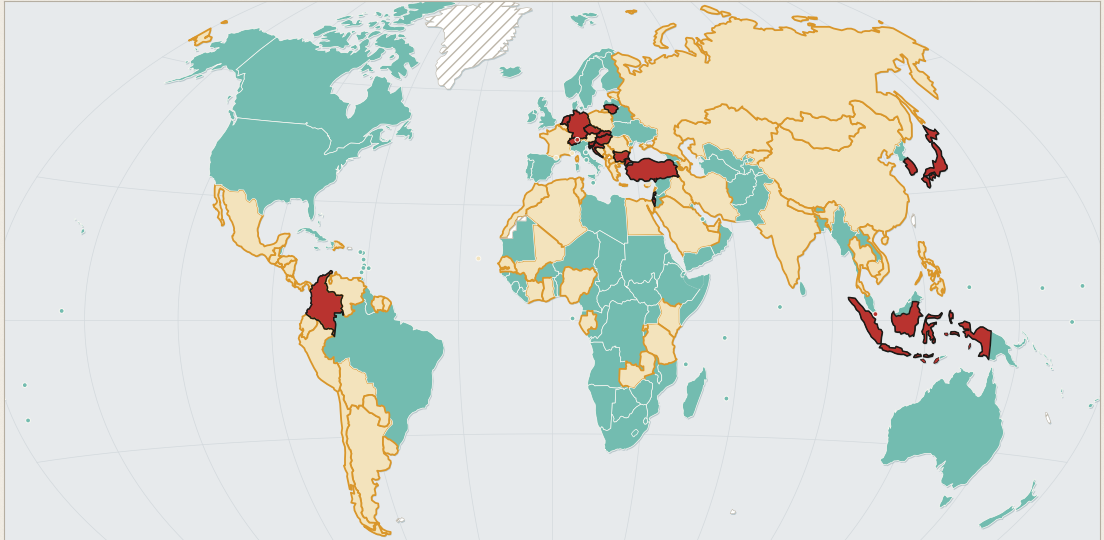 Health InsuranceMandatory in 18 countries Watch the map
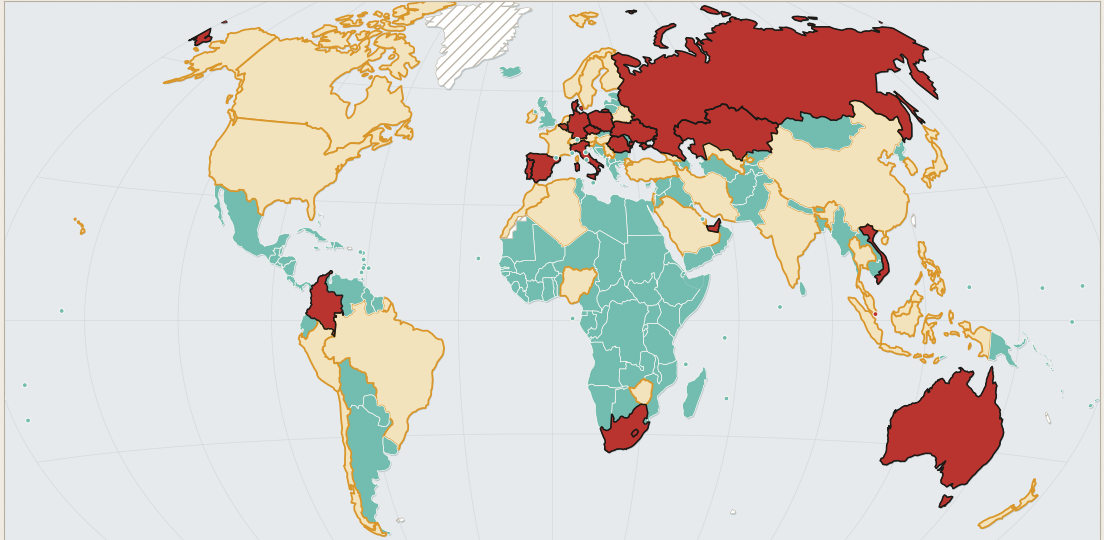 JaywalkingBanned in 18 countries Watch the map
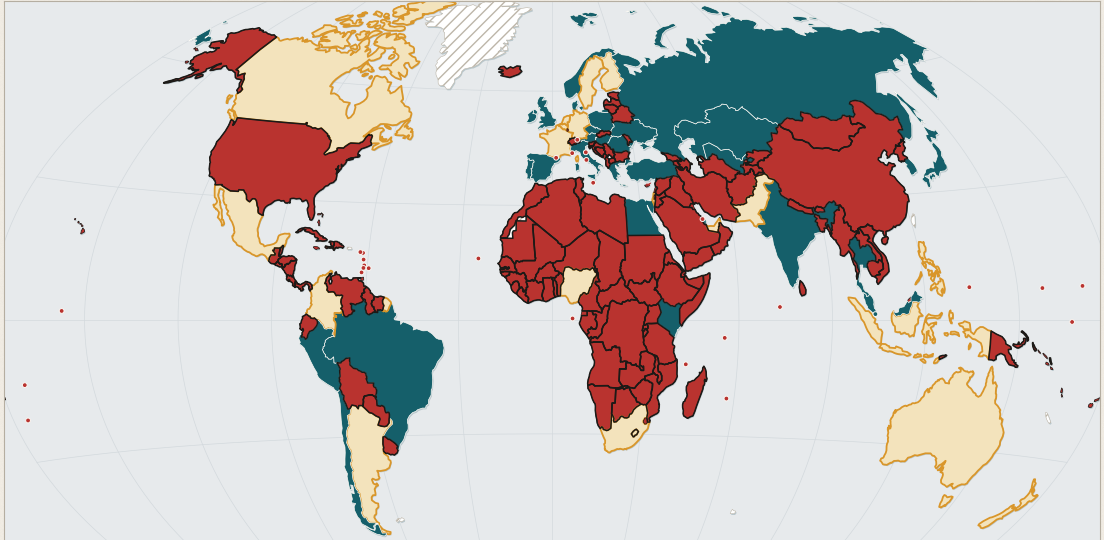 AmbulanceFree in 30 countries Watch the map
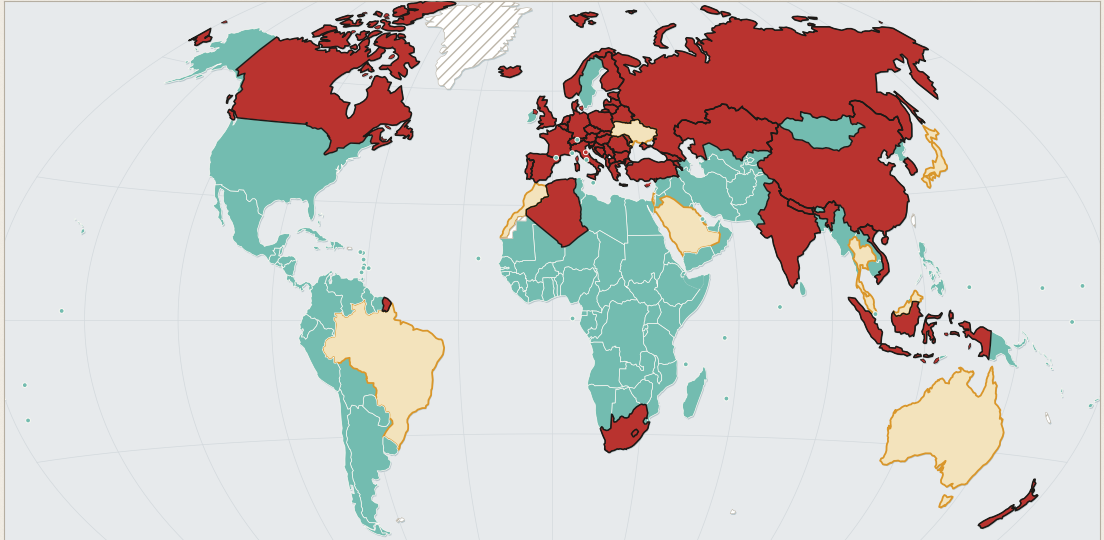 Choosing Your Baby's SexBanned in 50 countries Watch the map
 Cat MeatBanned in 5 countries Watch the map